
The technical part of a smart metering rollout is the part everyone plans for. Meters arrive, technicians install them, data flows to a head-end system. It is schedulable. It is measurable. It is the part that goes in the Gantt chart.
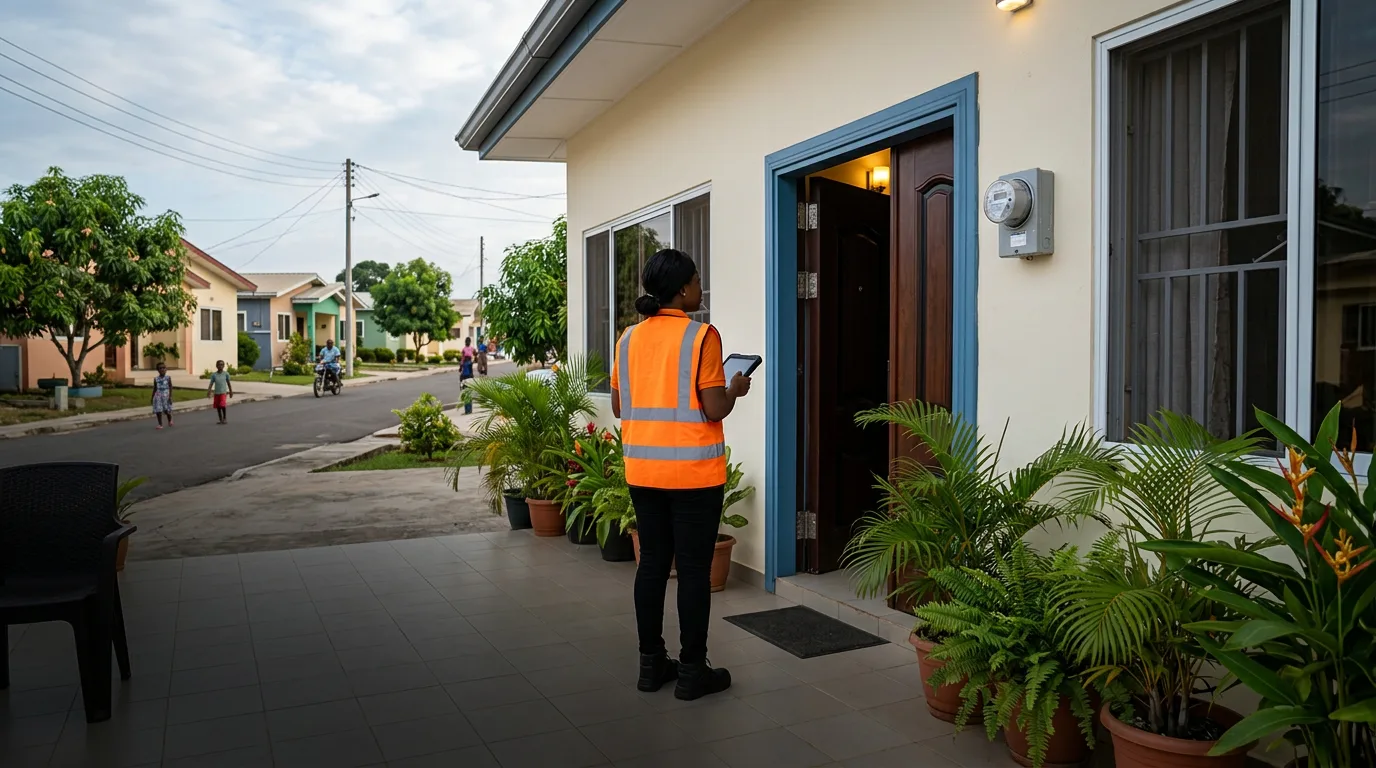
The part that decides whether the programme succeeds happens somewhere else entirely: at a front door in Paynesville, where somebody has to explain to a household why the box on their wall is changing, what it will cost them, and why this is not another thing being done to them.
Senapt's Liberia programme, delivered with the Liberia Electricity Corporation, is built around that conversation. More than 30 communities are now engaged across the country, with the focus on education and trust rather than installation volume.
Survey before you install
Every rollout wave in Liberia starts with a door-to-door survey. Field teams map each connection before a single meter is scheduled: what is connected, how it is wired, who the account belongs to, what the household actually needs.
This is unglamorous and it is non-negotiable. A survey that gets the connection wrong produces a meter that gets the bill wrong, and a bill that is wrong once costs more trust than ten correct ones earn back. It also produces something a utility running on estimates has never had: an accurate picture of its own customer base, built street by street.
Community engagement began formally on 17 April 2026, four days after the national launch, with LEC-Senapt Community Engagement: Phase I in Paynesville City, Montserrado County. The message was direct: transparency in what you are charged, better control of your electricity, and an end to the theft that degrades supply for everyone on the feeder.
Enrolment is a conversation, not a form
Community meetings and customer briefings run ahead of each deployment wave. Residents hear how prepaid works before a technician arrives, not after.
The explanation is practical. You buy credit through mobile money or an authorised vendor. You receive a 20-digit token. You load it, and you can see exactly what you are using, in real time, as you use it. When credit runs low, the meter tells you before the lights go out, not after. Installation takes under an hour, and during the rollout there is no installation fee for existing LEC customers.
The questions that come back are the ones you would expect. Will my bill go up? Who reads the meter now? What happens if it breaks? Answering those in a community hall, before installation day, is what turns an enrolment target into an enrolled customer.
Radio carries further than a field team can walk, and in Liberia it reaches households a door-to-door schedule will not touch for weeks. Running awareness on air ahead of the survey means the survey team arrives expected rather than unannounced, which is the difference between a door that opens and one that does not.
The technicians are Liberian
On 13 July 2026, staff and contractors gathered at Senapt's Liberia office at Rehab, Paynesville, for technical training in meter assembly, quality control, safety and operational skills.
This matters more than it sounds. Smart meter rollouts around the world are hitting a workforce ceiling long before they hit a technology one: there are meters available and nobody qualified to install them. Programmes that import their installation capacity leave nothing behind when the trucks go home, and the utility inherits an estate it cannot service.
Senapt's approach in Liberia is the opposite. Certified technicians install area by area, trained locally, so support stays close to the customers it serves and the capability remains in-country after the rollout ends. A household that needs help talks to somebody who lives nearby.
Deployment follows the trust
With survey, enrolment and training in place, installation moves through an area as a wave rather than scattering across the city.
The network-side work runs ahead of it. In July, joint Senapt-LEC teams assessed the LEC Paynesville Substation to place Mega X meters across four feeders. In August, Magno 33 CT meters went onto each transformer in the project zone, starting with feeder 1. Household meters (Magno 12m for single-phase homes, Magno 22 for dense urban installs and Magno 33 DC for three-phase businesses) then land inside a section of network that is already measured at the top.
That structure is what lets LEC show a community something specific: this is what your transformer delivered, this is what your street was billed, and here is the gap closing.
What this adds up to
A meter is a measurement device. A metering programme is a relationship with a household, a neighbourhood, a country, and it holds or fails on whether people believe the number.
In Liberia, that is being built one survey, one briefing, one broadcast and one installation at a time, across Paynesville and outward through Monrovia.